|
|
I’m reading Kuhn’s *The structure of scientific revolutions* slowly after glancing at bits of it over the years.
I’m struck by its deliberately archaic and lugubrious tone at times, which I think reflects the Harvard environment it came from (it takes one to know one). But despite that–it’s got an extraordinary amount to think about in terms of the emergence of what is touted as a new ‘discipline’, i.e., community informatics, as a one of the applied social sciences (and that is a debatable statement).
C.I. has been pushed into particular paradigms by its key exponents, whether or not those paradigms and what Kuhn calls exemplars are adequate to the task. This even explains the difficulty of getting the language ‘right’. Is it community informatics or community technology? How is ‘community’ conceived, or not conceived and so on? What constitutes the ‘community of practice’? What are acceptable operations and practices?
Combine that with Foucault’s criticisms of the operations of power and what he calls the technologies of power, and you have an ongoing critical theory that serves to deliberately keep any researcher or practitioner on edge about truth claims, for what is roped in as an academic and practice discipline as people struggle to carve out their niches (as a matter of professional and personal survival).
Having such a critical approach acts as a warning particularly when we are engaged in relationships with dominant powers (ie funders, governments). What are the truth claims that we make? Are their and our expectations intellectually justifiable and defensible? This might help pull us away from some of the hype about technology into a much better examination and knowledge of the nature of different communities (public communities, constructed communities, professional communities), working with those communities, and the place of technology in the change process in such communities. I assume here that at least ‘change’ is a core value and process in community informatics and technology.
PhD Thesis, Monash University, Faculty of Information Technology, 2006.
My thesis is posted on the assumption that it won’t be plagiarized or otherwise abused. Plagarism is theft, including the unacknowledged use of original diagrams and figures. If you cite or otherwise use such a document, acknowledge it!
Stillman PhD
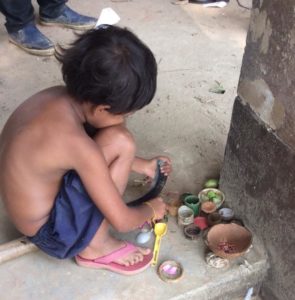
 Kids and Digital Doorway
Grant Cambridge, who is one of the very clever engineers with a social justice bent has been spending some time with my colleagues and I in Australia in order to develop interest in promoting this robust of mass-computer experience for remote communities. It’s the complete opposite, it seems to the One Lap Top per Child (OLPC) philosophy. For more about the DD, see the DD website, and some of the papers on the site you are looking at.
Unlike the OLPC (or the general thrust of computing):
- its not about individuals for either use or ownership in most of the world. People are simply too poor, don’t have electricity, or have other priorities than owning a computer. They often don’t even have a safe place to put a laptop, or it might get sold or stolen.
- to those who say then, well why should be develop or impose a computer upon such poor people, we can say ’so should we deprive them of an opportunity for self-empowerment and learning’? If the relative cost becomes quite low for supplying a few DD to hundreds or thousands of kids, then the apparently high purchase cost in comparison to a OLPC or one of the spin-off lightweight minicomputer is that justified by the documented very large use, robustness of the system (they don’t break), and that kids learn and older people gain confidence to have a go.
- The DD is NOT connected to the internet. That’s the best way of stopping porn or other undesirable content that frightens off the engagement of traditionally-oriented communities. It’s been a big problem in indigenous communities in Australia.
- However, the DD can mimic a lot of internet content through caching and remote administration /GPS or satellite content and software grades (or a secure USB) that gives school kids a very good internet-like experience to help with their school experience. And if they can create and share content between a DD network- such as films and music– then it becomes a safe form of intranet. This to me, does not seem to be a limit on free speech from a civil liberties perspective because it is about protecting vulnerable children and building community confidence and capacity.
But it’s also an argument that is wrapped up in the fetishism of commodities at a political level. The DD isn’t pretty: it’s designed for weather extremes and thousand of users and the occasional vandal. But it is still hard to ’sell’ that practicality to bureaucrats and politicians who are an easy catch for well-heeled vendors of the latest shiny gadget which is great for secure middle class people, but not so great in unsafe environments.
I think the best way of explaining the DD is that it’s a contemporary form of the phone box: tough as nails, and available to many people for whom the personal computer is a luxury and a practical impossibility for the foreseeable future. And even if broadband and wireless networks are set in place in remote Australia, the is still a need for computer systems that are ‘gold plated’ for their reliability.
If the right mix of off-line and online can be developed (for example to various educational or social support channels) can be put in place, in conjunction with content and access options as preferred by communities themselves, then there could be a lot of potential in very poor and isolated parts of Australia and the region for increasing the range of content and services that it offers.
But its point of ‘capture’ as a tool for the community is that it has got to be desired by a community and particularly its leadership (however complex such structures and relationships are), and as Grant has said, putting in a Doorway is easy: it’s the community buy-in that is the tough and ambigous nut to crack and this can take many months. This of course, is familiar in community development, but not something that politicians or planner and technologists often have much patience for.
What? In another life, I was a real scholar. If you don’t know about Assyriology, have a look at this information in Wikipedia. I was actually taught by some of the people listed in that article.
I published a couple of articles and here is the text of one about some tablets in Australia.
This is a pre-publication draft of : Stillman, L., S. Kethers, et al. (2009). “Adapting corporate modelling for community informatics.” VINE: The Journal of Information and Knowledge Management Systems 39(3): 259 – 274.
Purpose
To address the need for responsive methodologies to investigate how ICTs are used in non-business and non-corporate environments.
Design/methodology/approach
The article, based presents a case study on developing an IT strategic plan in a community organization using the process modelling and analysis methodology called ‘Co-MAP’.
Findings
Co-MAP as a methodology is significant in being a participatory, responsive, and non-obtrusive tool to work with welfare workers in getting to articulate information, knowledge and technical issues for decision-making.
Research limitations/implications
The research provides a way of obtaining knowledge about structuring of social-technical relationships in a welfare organization through a sympathetic approach to its business and culture.
Practical implications (if applicable)
Co- MAP could be fruitfully used in other organizations, though whether this needs an external facilitator to carry out the process and manage the complex data analysis process is a moot point.
Originality/value
The significance of this case study is that it develops a model for adaptation of how to research and represent data, information, and knowledge flows within a social services organization, for which there are few other detailed case studies.
Key Words: case study, community-based organizations, community informatics, process modelling, structuration theory.
VINE Draft paper
|
|